
Please Call 1st for Collections
Order Easily Online – 200+ Products
COLLECTIONS – Call to check availability
Open 8:00 – 17:00 • Mon-Fri (Excluding bank holidays)
Go to Checkout to Get Your Delivery Cost
Archery Net Frame Built from Used Scaffold Tubes in Southampton
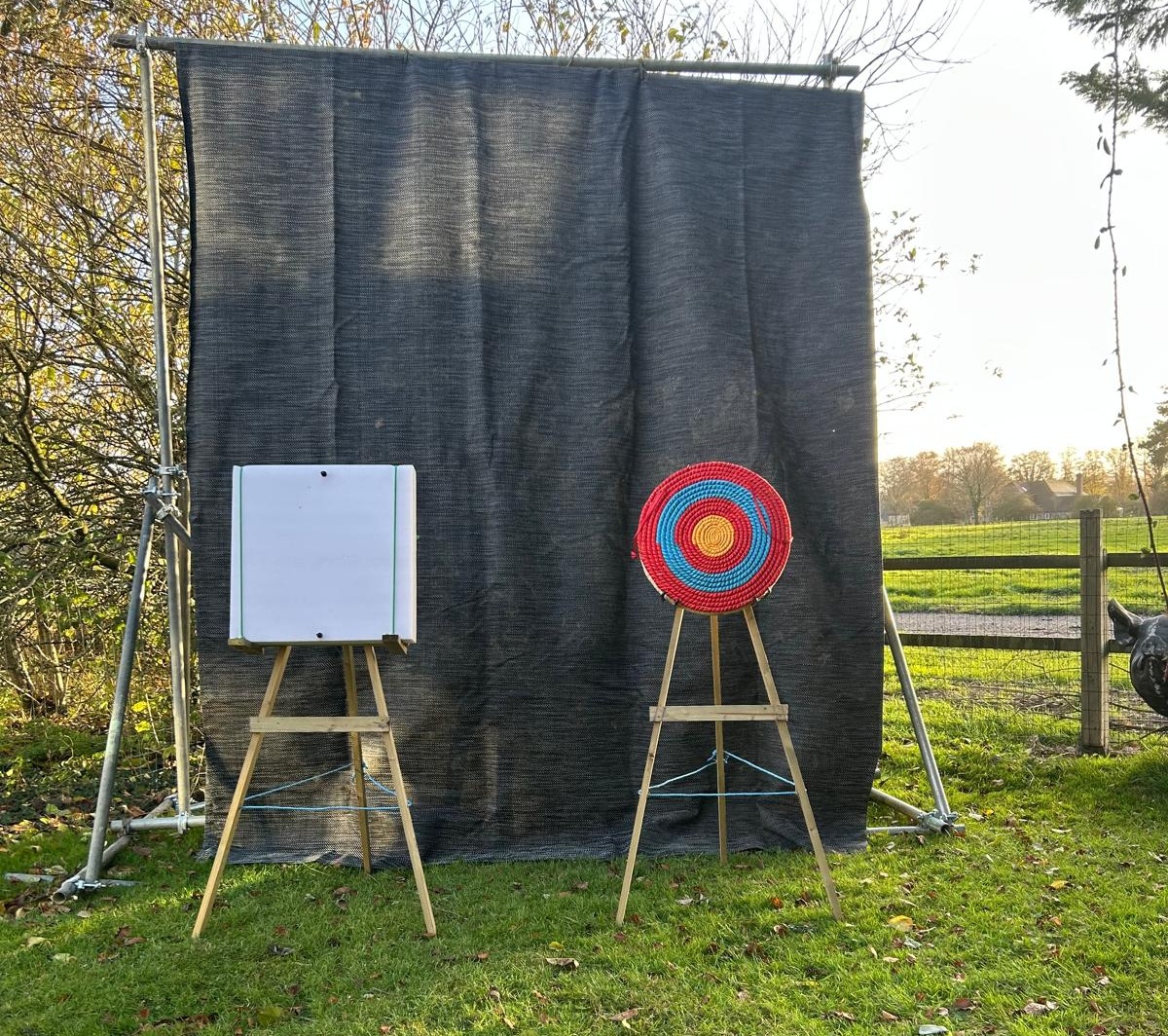
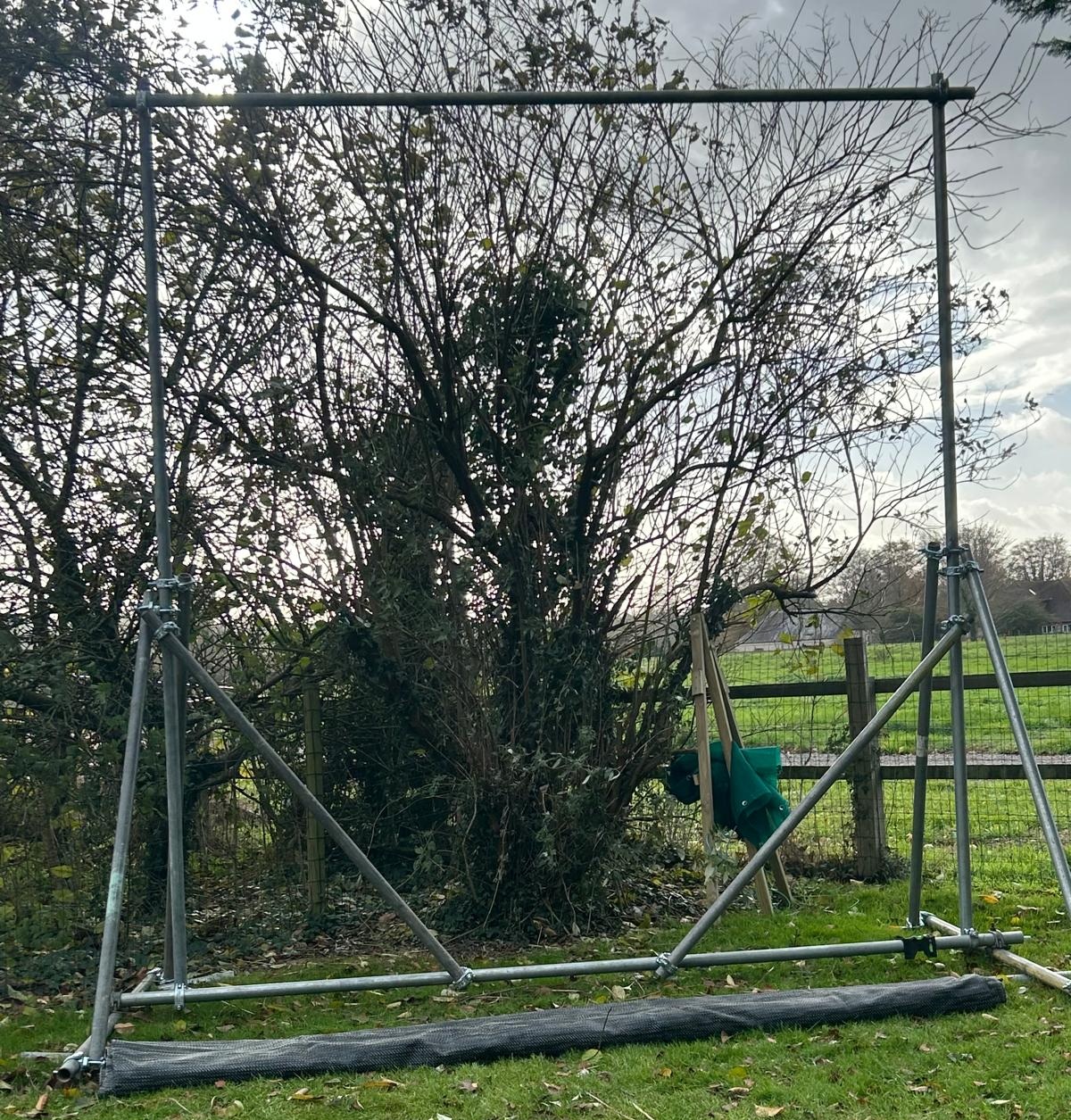
A customer in Southampton used scaffold tubes to construct a freestanding archery frame designed to support a backstop net behind their targets. The framework was assembled on a grassed area beside a post-and-rail fence, with trees and hedging in the background. The customer supplied two photographs of the project, one showing the completed setup with the net and targets in position and the other showing the exposed tubular framework.
Construction of the Archery Frame
The uprights and upper horizontal rail were formed from used 10ft scaffold tubes, with the framework also incorporating 6ft lengths. The top rail extended slightly beyond both uprights, making the opening marginally narrower than the overall tube length. This provided sufficient width to accommodate two archery targets positioned side by side.
Each upright is supported by angled raker tubes extending to the ground, forming a freestanding structure that does not rely on the adjacent fence or hedge for support. Short horizontal tubes connect the feet of the rakers to the base of each upright.
A longer horizontal tube spans the width of the framework just above ground level. Two diagonal braces extend upwards and outwards from this tube, connecting to the respective uprights. This arrangement of rakers and bracing is intended to maintain the frame’s shape and resist sideways movement, particularly when the backstop net is attached and exposed to wind.
Connecting the Tubes with Swivel Couplers
New swivel couplers were used throughout the framework, allowing the tubes to be connected at varying angles. These fittings were particularly suited to the rakers and diagonal braces, where the tubes meet at angles that cannot be accommodated by standard right-angle couplers. The rotating mechanism also let the customer adjust each raker’s angle to its position on the grass.
Combining second-hand scaffold tubes with new fittings helped keep material costs down while providing unused bolts and threads at each connection.
Positioning the Backstop Net and Targets
The dark woven mesh net is suspended from the upper horizontal tube, extending almost to ground level and covering most of the opening between the uprights. It reaches well above both targets, providing coverage above and behind them.
With the net in place, some rakers and ground-level tubes remain visible on either side. In the second photograph, the mesh has been rolled up along the base of the frame, revealing the arrangement of tubes and fittings used in its construction.
Two archery targets are positioned in front of the net on wooden easels, with blue cord connecting the legs of each stand. The target on the left is a rectangular white foam block secured with green straps, while the one on the right is a circular rope target with red, blue, and yellow rings. Both are positioned at a similar height, approximately halfway up the net.
Related Scaffold Tube Project
A customer also repurposed galvanised steel poles to build a fruit-growing structure in Bognor Regis, with each upright drilled at three different heights to accommodate support wires.
Building a Similar Framework
For anyone considering a similar project, scaffold tubes will be needed for the uprights, top rail, rakers and diagonal bracing, along with suitable fittings for each connection. Where tubes meet at 90 degrees, such as the top rail and uprights, right-angle couplers can be used to form fixed connections.
Tighten all fittings with a scaffold spanner and check them periodically, particularly where the framework stands on soft or uneven ground. Suitable base plates and sole boards can help distribute the load and reduce the likelihood of the uprights sinking.
One advantage of using scaffold tubes and couplers is that the components can be assembled without welding. The framework can be dismantled, relocated or reconfigured using different tube lengths, subject to suitable bracing and stability requirements.
Any archery backstop should suit the equipment being used, with adequate safety clearance behind and around the targets.