Fast Delivery - Checkout for Costs

Please Call 1st for Collections

Order Easily Online – 200+ Products

Bulk Discounts – Trade Prices

COLLECTIONS – Call to check availability

Open 8:00 – 17:00 • Mon-Fri (Excluding bank holidays)

Go to Checkout to Get Your Delivery Cost

Scaffold Poles

We supply high-quality scaffold poles (also known as scaffolding tubes or pipes), which are essential components of tube-and-coupler scaffolding systems.

Showing all 10 results

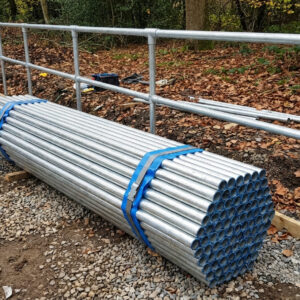
These hot-dip galvanised tubes offer excellent corrosion resistance and durability, with a standard diameter of 48.3mm. We offer lengths of 5ft, 6ft, 8ft, 10ft, 13ft, 16ft, and 21ft, and wall thicknesses of 3.2mm or 4.0mm. They meet BS EN 12811-1 and EN 39 standards. To create your scaffolding platform or DIY structure, view our new 48.3mm scaffold tubes, made from fresh galvanised steel in all standard sizes, or choose our used scaffold poles, which provide a cost-effective option that remains structurally sound. We also stock specialised galvanised handrail tubes ideal for safety railings and barriers, including the popular 42.4mm handrail pipe for robust guardrails, the versatile 33.7mm railing tube for lighter safety frameworks, and the compact 26.9mm safety rail tube suitable for handrails and smaller projects. Pair them with our scaffolding fittings or tube clamps to securely connect everything.


Frequently Asked Questions

A scaffolding pole (tube or pipe) is a hollow and cylindrical length of galvanised steel, which typically has a 48.3mm diameter and either a 3.2mm or 4mm wall thickness. These poles are assembled with couplers and fittings to form the structural frame of a scaffold.

Tubes play a fundamental role in scaffold construction, fulfilling the following critical functions:

Vertical support standard poles (legs): These transfer structural weight to the ground.

Horizontal support ledger poles: These connect to the vertical standards and transoms, enhancing stability.

Transom poles: They provide support for scaffold boards and form the working platforms.

Braces: They enhance structural stability and prevent movement.

Handrails: These poles provide edge protection and improve worker safety on platforms.

Scaffold poles are used well beyond scaffolding. Common projects include: constructing tree supports, table and furniture frames, storage solutions, artistic displays, market stalls, children’s climbing frames, protective fencing, signage banners, gym equipment, lighting rigs, film sets, and exhibition stands, to name just a few examples.

The most common scaffolding fittings, also called couplers, clamps or connectors, are compared below. All are made from galvanised steel (hot-dip or electro-galvanised for corrosion resistance) and are designed for 48.3mm OD tubes in tube-and-fitting (tube-and-clamp) scaffolding systems.

They comply with international standards like BS1139 and EN74 (Class A or B), ensuring safe connections in horizontal, vertical, and diagonal positions to form a strong, stable framework. The specific type depends on the project’s structural needs, load requirements, and configuration.

Type of Fitting / Coupler

Also Known As

Primary Function / Connection Type

Typical Use / Position

Load-Bearing Notes

Common Manufacturing Style

Right-Angle Coupler

Double Coupler, Fixed Coupler, 90° Coupler

Joins two tubes at a fixed 90° (right) angle

Connecting standards (verticals) to ledgers/transoms (horizontals); main framework

High – primary load-bearing; resists tension/compression

Drop-forged or pressed steel

Swivel Coupler

Swivel Clamp

Joins two tubes at any angle (360° rotation)

Diagonal bracing, flexible connections, ties; adapting to irregular shapes

Medium to high – suitable for bracing

Drop-forged or pressed steel

Putlog Coupler

Single Coupler

Joins a tube to a horizontal member at 90° (single-sided grip)

Attaching transoms/putlogs to ledgers/standards; supporting scaffold boards/platforms

Lower – non-primary load-bearing (use only where design allows)

Forged or pressed steel

Sleeve Coupler

External Joint Box, Joiner

Joins two tubes end-to-end (externally)

Extending tube lengths (ledgers, standards, braces); spanning gaps

High in tension/compression when properly used

Mostly pressed steel

Board Retaining Coupler

BRC, Toe Board Clamp, Board Clamp

Secures scaffold boards/planks to tubes

Preventing boards from slipping; edge protection/side safety

Low – safety/anti-slip function

Forged or pressed steel

Beam / Girder Coupler

Gravlok, Beam Clamp

Attaches tubes to structural steel beams/I-beams (fixed or swivel versions)

Anchoring scaffold to existing structures; bridging or tying to girders

High – for heavy loads/transfers

Forged (often used in pairs)


Key notes:

  • These fittings are tightened with standard scaffold spanners (typically 23 mm A/F nuts/bolts) for secure, slip-resistant connections.
  • Drop-forged versions are heavier-duty and more common for demanding projects; pressed-steel versions are lighter and cost-effective for general access.
  • Always select based on project design, load calculations, and local regulations — never substitute (e.g., don’t use putlog couplers for main load-bearing joints).
  • Other less common/specialised fittings include ladder clamps, joint pins (internal end-to-end), limpet clamps, etc., but the above cover the core essentials.

They are made from hot-dip galvanised steel.

The table below shows roughly how many galvanised scaffold tubes make up one tonne (1,000 kg), using standard UK industry weights.

These estimates are for the common lengths we stock (5ft to 21ft), with a consistent 48.3 mm outside diameter. The numbers vary slightly depending on the exact wall thickness (3.2 mm high-yield/lightweight vs. 4.0 mm heavy-duty), galvanising, and minor manufacturing tolerances — always verify with your supplier for precise deliveries.

The figures below are widely quoted averages (primarily aligned with 3.2 mm high-yield tubes, which are now the most common for new stock due to being ~20% lighter while maintaining strength):

Length (Imperial)

Length (Metric approx.)

Approx. Weight per Tube (3.2 mm wall)

Approx. Weight per Tube (4.0 mm wall)

Approx. Poles per tonne (3.2 mm)

Approx. Poles per tonne (4.0 mm)

5 ft

1.5 m

5.4 kg

6.7–6.9 kg

185

145–150

6 ft

1.8 m

6.5 kg

8.1–8.2 kg

154

122–125

8 ft

2.4 m

8.6–8.7 kg

10.6–10.9 kg

115

92–95

10 ft

3.0 m

10.8 kg

13.3–13.6 kg

92

73–75

13 ft

3.9–4.0 m

14.0 kg

17.3–17.7 kg

71

56–58

16 ft

4.8–4.9 m

17.3 kg

21.3–21.8 kg

57

46–47

21 ft

6.4 m

22.7 kg

28.0–28.6 kg

44

35–36

Key notes:

  • These are approximate – absolute counts can vary by 5-10% due to galvanising thickness, exact steel density, and supplier tolerances.
  • 3.2 mm (high-yield S355 grade) tubes are lighter and more popular today (easier to handle, with the same strength in most applications).
  • 4.0 mm (traditional Type 4) tubes are heavier, so fewer fit in a tonne.
  • Suppliers often bundle tubes in packs of ~61 lengths for transport efficiency.
  • For bulk orders (e.g., full lorry loads), the per-tonne count helps with logistics and cost planning.

Scaffolding tubes offer several key benefits:

Enhanced safety and durability: They are constructed from high-quality galvanised steel and so provide strong, reliable support for personnel and materials. Their corrosion resistance ensures longevity in outdoor environments.

Flexibility and adaptability: They come in pre-cut lengths and can be built around awkward structures to reach almost any area safely.

Improved efficiency and speed: Scaffold poles are available in standardised diameters with compatible couplers, enabling swift assembly and disassembly, reducing downtime, and boosting productivity.

Economic advantages: Reusable scaffolding poles present a cost-effective solution compared to rentals, with the initial investment recouped through repeated use across multiple projects.

A broad range of applications: Other than construction, these tubes are adaptable for various purposes, including event staging, signage support, and maintenance operations.

High-yield scaffold tubes, or high-tensile S355 tubes, provide the same strength as standard 4.0mm thickness poles but are lighter and easier to manage due to their 3.2mm wall thickness and improved strength-to-weight ratio.

The cost per foot for a new scaffolding pole fluctuates based on the quantity you’re buying, current market conditions, and how readily available it is. Generally, though, you can anticipate a price range of 90p to £1.85p per foot.

Yes, our scaffold tubes are hot-dip galvanised for excellent corrosion resistance and durability.

We supply 5ft, 6ft, 8ft, 10ft, 13ft, 16ft and 21ft scaffold poles.

Yes, we stock both new and used scaffold poles in a range of standard lengths.

Standard scaffold poles have an outside diameter of 48.3mm and are compatible with standard scaffold fittings and clamps.

These are all names for the same 48.3mm scaffold tube, the name just refers to where it sits in the structure and the job it does:

  • Standards are the vertical uprights that carry the load down to the ground.
  • Ledgers run horizontally between the standards, tying the frame together and supporting the transoms.
  • Transoms sit across the ledgers and hold the scaffold boards that form the working platform.
  • Braces run diagonally to stop the structure swaying.
  • Handrails provide edge protection along the platform.

Because they’re the same tube, you don’t buy a “ledger” or a “transom” as a separate product, you order the length you need and use it in the right position. As a rough guide, ledgers tend to be longer runs (commonly 13ft or 21ft) and transoms shorter (often 5ft or 6ft).

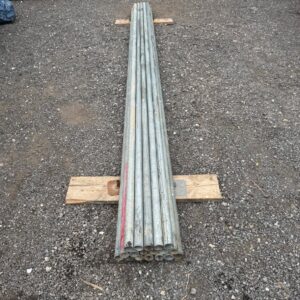
New tubes are freshly galvanised and unmarked, so they look clean and are ideal where appearance matters. Used tubes are structurally sound and fully serviceable, but will show signs of previous use, scuffs, surface marks or minor wear at the ends. For most access scaffolds and DIY builds either works: used simply gives you the same 48.3mm tube at a lower price. Both come in the same standard lengths.

Yes, the more you order, the lower the price per tube, so larger and full-load quantities work out cheaper per foot. Add what you need to your basket and go to checkout to see your delivery cost. For a large or repeat order, give us a call and we’ll help you get the right quantities.

Latest customer purchases