


Why Choose a GRP Tower Over Aluminium?
If your work never goes near power lines, switchgear, substations or overhead cabling, an aluminium tower will usually do the job for less money. But the moment electrical risk enters the picture, GRP (glass-reinforced plastic) becomes the sensible choice, not an optional upgrade.
For general construction and maintenance work where electrical conductivity isn’t a concern, a lightweight aluminium scaffold tower can be more practical. Our professional aluminium AGR mobile access tower provides a stable mobile working platform for safe access when working at height.
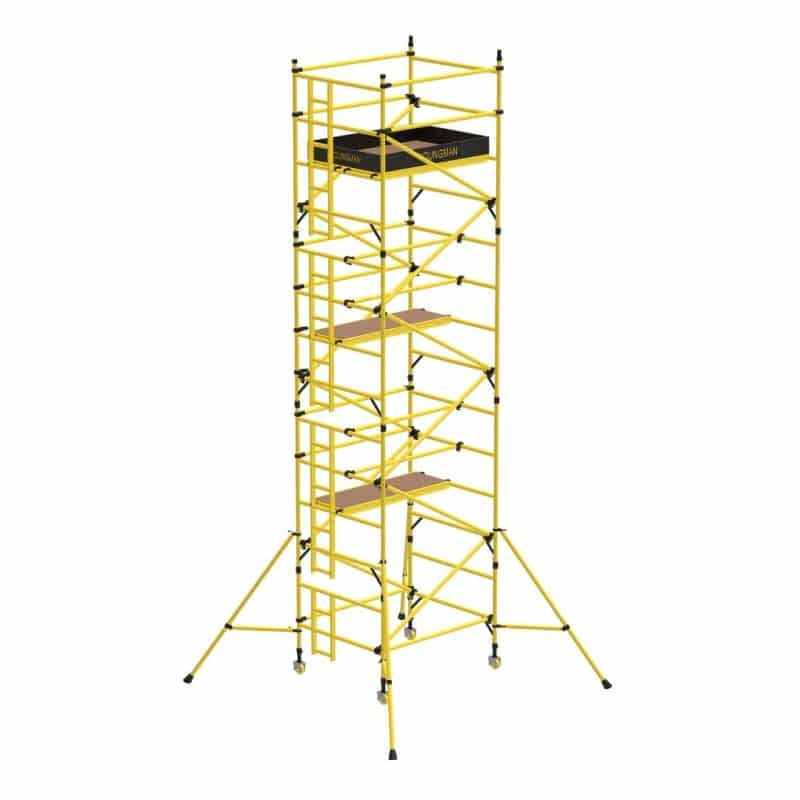
Because GRP doesn’t conduct electricity, electricians, telecoms engineers, railway maintenance teams, and anyone working in or around substations, plant rooms, and live environments use this tower widely. It’s also naturally resistant to corrosion, so it holds up well outdoors, around chemicals, or in damp and coastal sites where aluminium towers eventually pit and corrode.
The trade-off is weight: GRP is heavier than aluminium of the same size, so we’ve listed the exact weight for every height and width combination below, so you can check it against your access requirements and how many people will be moving it.
Choose Your Size
This tower is built around two platform widths and two base lengths, giving you four footprints to choose from:
Width | Length | Base Footprint | Best suited to |
Single (0.85m) | 1.8m | 1.8m x 0.85m | Tight spaces, corridors, stairwells, single-person tasks |
Single (0.85m) | 2.5m | 2.5m x 0.85m | Longer runs of work — cladding, guttering, cable runs — where you don’t need extra platform width. |
Double (1.45m) | 1.8m | 1.8m x 1.45m | Two operatives working side by side, or where you need more room for tools and materials. |
Double (1.45m) | 2.5m | 2.5m x 1.45m | Larger jobs needing both extra length and extra platform width — the most stable and spacious footprint in the range |
As a general rule: go longer (2.5m) if you’re covering more ground along a wall or run of cable, and go double width (1.45m) if you need two people, or more tools and materials, on the platform at the same time. Combining both gives you the most stable and capable tower in the range, but also the largest footprint and the most weight to manoeuvre, so it’s worth checking your access route and doorway widths before you order.
Working Heights & Full Specifications
All four sizes are available at 4.2m, 6.2m and 8.2m working height. Platform height is always 2m below working height, in line with the standard formula for calculating a safe reach height on a tower.
| Size | Working Height | Platform Height | Base (L x W) | Tower Weight | Max Load / Platform | Max Load / Tower |
|---|---|---|---|---|---|---|
| Single Width 1.8m | 4.2m | 2.2m | 1.8m x 0.85m | 97.1kg | 275kg | 950kg |
| Single Width 1.8m | 6.2m | 4.2m | 1.8m x 0.85m | 172.1kg | 275kg | 950kg |
| Single Width 1.8m | 8.2m | 6.2m | 1.8m x 0.85m | 231.4kg | 275kg | 950kg |
| Single Width 2.5m | 4.2m | 2.2m | 2.5m x 0.85m | 112.1kg | 275kg | 950kg |
| Single Width 2.5m | 6.2m | 4.2m | 2.5m x 0.85m | 199.0kg | 275kg | 950kg |
| Single Width 2.5m | 8.2m | 6.2m | 2.5m x 0.85m | 270.3kg | 275kg | 950kg |
| Double Width 1.8m | 4.2m | 2.2m | 1.8m x 1.45m | 132.5kg | 275kg | 950kg |
| Double Width 1.8m | 6.2m | 4.2m | 1.8m x 1.45m | 217.5kg | 275kg | 950kg |
| Double Width 1.8m | 8.2m | 6.2m | 1.8m x 1.45m | 286.9kg | 275kg | 950kg |
| Double Width 2.5m | 4.2m | 2.2m | 2.5m x 1.45m | 153.4kg | 275kg | 950kg |
| Double Width 2.5m | 6.2m | 4.2m | 2.5m x 1.45m | 250.7kg | 275kg | 950kg |
| Double Width 2.5m | 8.2m | 6.2m | 2.5m x 1.45m | 332.4kg | 275kg | 950kg |
Maximum working load per platform (275kg) and per tower including tower weight (950kg) are the same across every size and height in this range.
What's Included as Standard
Every tower in this range is supplied as a complete kit; you’re not left having to source extra parts to make it compliant. As standard, you’ll get:
- Locking castors and adjustable legs, so the tower can be levelled on uneven ground and locked off once in position
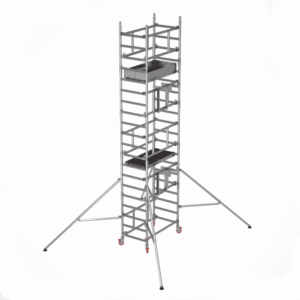
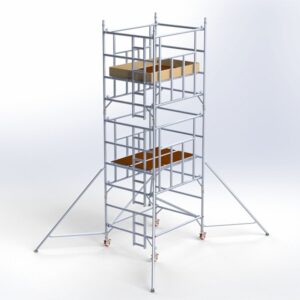
- A ladder frame and span frame set sized to your chosen height, giving you an integrated climbing frame rather than a separate ladder to carry
- A trapdoor platform for safe, enclosed access from below, plus a fixed platform
- A full set of horizontal and diagonal braces to tie the frame together
- Stabilisers (small or large, depending on height) to widen the tower’s footprint at taller builds
- A folding toeboard, fitted as standard rather than sold separately
The exact quantity of each component scales with the height you choose; taller towers naturally need more frame sections and bracing, but every size is supplied ready to build to current guardrail and toeboard requirements, with nothing missing from the box.
Built to EN 1004-2020
This tower is manufactured to meet EN 1004-2020, the current British and European standard for mobile access and working towers. In practice, that means the frame, platforms, bracing and stabilisers have all been designed and tested to work together as a single compliant system, rather than as parts that happen to fit. If your site or principal contractor asks for proof of compliance before you’re allowed to erect a tower, this is the standard they’ll be checking against.
Who Uses This Tower
GRP towers earn their keep wherever a metal tower would be a genuine electrical hazard, but they’re also a solid general-purpose choice anywhere corrosion resistance matters:
- Electricians and electrical contractors working near switchgear, distribution boards or live circuits.
- Telecoms and data engineers working around cabinets, masts and comms rooms
- Rail and utility maintenance teams working near overhead lines or trackside equipment.
- Facilities and maintenance teams in plant rooms, substations and industrial sites with exposed electrical infrastructure.
- Anyone working outdoors long-term, or in damp, coastal or chemically aggressive environments where aluminium would corrode over time.
If GRP isn’t essential for your application, we also supply aluminium access equipment for construction, maintenance and general work at height. Explore our range of mobile scaffold towers in different sizes with a choice of working heights and platform configurations to suit different access requirements.
Frequently Asked Questions (FAQs)
What's Actually Different Between the Single-Width and Double-Width Versions?
Single-width towers have a 0.85m platform, wide enough for one person to work comfortably with hand tools. Double-width steps up to 1.45m, which gives you room for a second operative, or for materials and equipment to sit on the platform alongside you. The frames, braces and stabilisers are all sized differently to suit, so it’s not simply a wider deck bolted onto the same base, the whole tower is built for the extra width.
Can I Use This Tower for Live Electrical Work?
The GRP construction is non-conductive and widely used near electrical equipment, but “non-conductive tower” doesn’t override your site’s electrical safe working procedures. Always follow your company’s isolation and permit-to-work rules for the specific task, he tower removes one risk, not all of them.
How Many People Can be on the Platform at Once?
That’s governed by the maximum working load per platform (275kg), not by a fixed headcount, so it depends on the combined weight of the people, tools and materials up there. On a double-width tower, two people plus tools is typically well within that limit; check your own numbers against the 275kg figure before loading up.
Do I Need Training to Erect a Tower up to 8.2m?
Yes. Towers above 2m generally require the erector to hold a recognised competency card, PASMA is the standard qualification in the UK, and this applies regardless of whether the tower is aluminium or GRP. The height and component count both increase as you go from 4.2m to 8.2m, so a taller build takes longer and needs the same level of competent supervision throughout.
Are Stabilisers Required at Every Height in This Range?
Stabilisers become part of the standard component set from the taller platform heights in this range and widen the tower’s base footprint for extra resistance to tipping. They’re supplied as part of the kit at the heights where they’re needed, so you won’t need to buy them separately.
How Much Heavier is the Double-Width Tower Compared to Single Width, at the Same Height?
At 8.2m working height, single width (1.8m) comes in at 231.4kg, while double width (1.8m) is 286.9kg, roughly 55kg more for the wider platform and its extra bracing. Worth factoring in if you’re planning how many people you’ll need to move and store the tower.
Can This Tower be Used Outdoors and Left Assembled Overnight?
GRP resists weather and corrosion better than aluminium, so it’s a good choice for exposed or coastal sites. That said, leaving any mobile tower assembled and unattended overnight carries its own risks (wind loading, unauthorised access, theft), so check your site’s own policy on securing or dismantling towers outside working hours.
Is It Possible to go Higher Than 8.2m on the Same Base?
Yes, this range extends beyond the heights shown on this page, as the frame and platform system is modular by design. Get in touch and we can talk you through the taller configurations and what additional components they need.
Q & A




Reviews
There are no reviews yet