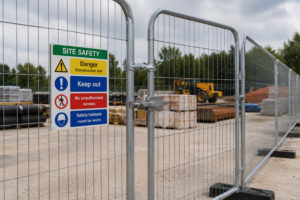
The benefits of crowd control barriers
Crowd control barriers are essential for maintaining safety and order at various types of events and on construction sites. By effectively managing crowds and controlling access, these barriers help to:
Control crowd flow: They guide and direct foot traffic to prevent congestion and bottlenecks.
Enhance pedestrian safety: They protect attendees from hazards like falling debris, equipment, and hazardous areas.
Secure restricted areas: They prevent unauthorised access to sensitive areas or equipment.
Optimise the event layout: create designated areas for specific activities or performances to improve the overall event experience.
Maintain emergency access: Crowd barriers ensure clear, unobstructed emergency exits and pathways for swift evacuation.
Types of crowd barriers
When it comes to size and style, standard crowd control barriers offer flexibility and versatility. Most crowd barriers are 2.3 meters wide and come in two different leg configurations. Colours include standard silver plus red and white barriers. We have detailed the two main 2 types of barriers below:
Pedestrian bar barrier: Detachable leg pedestrian bar barriers offer high flexibility and portability, making them easy to move and set up. They are made of steel tubes without attached feet, making them convenient for storage and transportation. You can purchase separate feet, such as flat steel or composite rubber, to ensure stability. Remember, for a continuous run, order one more foot than the number of barriers you need.
Fixed leg crowd control barriers: Fixed-leg crowd barriers provide a more permanent solution for crowd control, offering a sense of reassurance. These barriers are constructed with permanently attached feet, eliminating the need for separate feet and simplifying assembly.
Which is best? Fixed-leg vs loose-leg crowd control barriers?
Fixed-leg and loose-leg crowd control barriers are designed for easy assembly and disassembly. The choice between the two depends on your specific requirements, such as frequency of use, storage space, and level of customisation needed.
Which crowd barrier is better on soft ground?
When hosting events on soft ground, such as grass, loose-leg barriers with flat or rubber feet offer superior stability compared to fixed-leg barriers, which may sink into the ground.
Which crowd barrier is safer?
Fixed-leg barriers can be a potential tripping hazard due to their raised feet. In contrast, loose-leg barriers with low-profile feet minimise the risk of accidents and create a safer environment for attendees.
Crowd control barrier dimensions
When selecting the proper size crowd barrier for your project, it’s crucial to measure the overall width between the barrier’s hook points. This measurement is commonly 2.3 metres, ensuring you are well-informed and can make the best decision for your needs.
Pedestrian bar barrier dimensions:
The standard dimensions for loose-leg crowd control barriers are provided below. However, please note that specific barrier sizes may vary among different suppliers.
- Total height: 1.1m.
- Width with hooks included: 2.3m.
- Width without hooks included: 2.2m.
- Height between top & bottom bars: 90cm.
- Distance between infill bars: 10cm.
- Typical tubular diameter: 3.8cm.
- Distance from bottom bar to floor: 19cm.
- Weight: 12-14kg.