
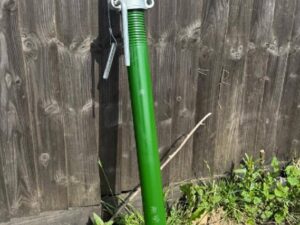


Our adjustable acrow props are your go-to for reliable vertical support on any construction project. Crafted from heavy-duty, green powder-coated steel, they offer excellent durability and rust protection, making them ideal for bracing load-bearing walls, ceilings, steel beams, and overhead structures. Each prop adjusts easily with a nut and handle, secured by a chainless pin. We stock five different sizes:
- Size 0: 1.04m – 1.83m.
- Size 1: 1.75m – 3.13m.
- Size 2: 1.98m – 3.35m.
- Size 3: 2.59m – 3.96m.
- Size 4: 3.20m – 4.87m.
Product FAQ's
What is an acrow prop?
Acrow props (also called adjustable steel props, acrow jacks, shore props, or post-shores) are robust metal struts. Their primary purpose is to prevent collapse by providing crucial support for overhead loads, such as walls, ceilings, beams, and formwork.
What heights are the acrow props available?
Our acrow props are available in the following sizes:
- Size 0:04m to 1.83m.
- Size 1:75m to 3.13m.
- Size 2:98m to 3.35m.
- Size 3:59m to 3.96m.
- Size 4:20m to 4.87m.
What are the inner and outer tube diameters of an acrow prop?
The diameter of this product remains consistent across all extendable sizes:
Outer tube: 60.3mm.
Inner tube: 48.3mm.
How much does each acrow prop weigh?
Here’s the approximate weight for each acrow size:
- Size 0: (12.95kg).
- Size 1: (18.64kg).
- Size 2: (19.00kg).
- Size 3: (22.57kg).
- Size 4: (26.36kg).
What are acrow props made from?
They’re constructed from powder-coated high-strength steel.
Are acrow props suitable for horizontal use?
No, you should never use an acrow prop for horizontal support. For that kind of bracing, trench struts are the recommended equipment.
How long is it safe to keep acrow prop in place?
The time acrow props need to stay in place really depends on your project and the materials you’re using. Here are some general guidelines:
Minimum: Usually, 24 hours is the shortest time, especially for masonry work, where the mortar needs to set.
Typical: 48 hours is a standard recommendation, particularly in warm, dry conditions. This gives mortar and other materials enough time to set correctly.
Extended Duration: If it’s colder or wetter, you might need to leave the props in place for longer to ensure everything cures correctly.
What is the maximum span allowed between acrow props?
Acrow props should typically be spaced at around 1-meter intervals, particularly when supporting brickwork or masonry. However, it is always advisable to consult a structural specialist for precise guidance on your specific project.
What are the most effective methods for bracing acrow props?
You can further secure this product using couplers and steel scaffold tubes. Simply attach the tube to the acrow in a diagonal or horizontal position, then connect it to the acrow with a prop-to-tube coupler or prop swivel coupler.
What is the safe working load (SWL) for acrow props?
An acrow prop can support a maximum weight of 4300kg. However, it is always advisable to consult a structural engineer.
Common mistakes when using acrow props and how to avoid them
We’ve supplied Acrow props to thousands of UK sites and often hear about these pitfalls—learning from them keeps projects safe and efficient.
- Over-extending the prop – Extending beyond the safe height range drastically reduces load capacity (e.g., a Size 2 prop drops from 39kN closed to 11kN fully open). Always choose the shortest prop that fits and check the manufacturer’s load table.
- Not plumbing vertically – Props must be no more than 1.5° out of plumb; tilting causes eccentric loading and failure risk. Use a spirit level every time.
- Unstable base – Placing on soft/uneven ground without sole boards or base plates can cause shifting. Always spread the load on firm surfaces.
- Over-tightening or hammering the collar – This damages threads; hand-tighten only with the handle.
- Using damaged props – bent tubes, rusty threads, or missing pins- compromises safety; inspect before every use.
Pro Tip: Brace multiple props with scaffolding tubes for heavy loads.
How to calculate the number of Acrow Props needed
No one-size-fits-all, but here’s a practical guide (always consult a structural engineer for critical loads).
Rule of Thumb (UK Residential): One prop (or pair with needles/Strongboys) per metre of opening width for wall support. For slabs/formwork: Space at 900mm–1m centres max; closer (600mm) for heavier concrete.
Basic Steps:
- Determine total load – Include dead load (structure weight) + live load (workers/materials). Get this from your structural engineer.
- Check prop capacity – Use our load ratings table (higher when closed/shorter).
- Divide load by prop SWL – Add safety margin (e.g., use 50–70% of max).
- Factor spacing – Even distribution prevents overload.
- For precise calculations – Refer to HSE guidelines or contact a qualified engineer – temporary works are no place for guesses!
HSE guidelines for using props (Acrow Props/Adjustable Steel Supports)
The Health and Safety Executive (HSE) classifies adjustable steel props (commonly known as Acrow props) as temporary works—engineered solutions that provide temporary support during construction, such as propping walls, floors, or formwork. They must be managed with the same rigour as permanent structures to prevent collapses, which often result in serious injuries.
Key guidance comes from HSE resources and BS 5975:2019 + A1:2024 (Code of Practice for Temporary Works Procedures), widely regarded as the benchmark for good practice.
Core HSE Requirements
- Competent Design and Assessment – Even for standard proprietary equipment like Acrow props, a competent person must assess loads, select the correct type/size/number, and determine spacing. This includes dead loads (structural weight), live loads (workers, materials), and lateral/side loads (often underestimated, leading to failures).
- Management and Coordination – Appoint a Temporary Works Coordinator (TWC) for medium/large projects (recommended in BS 5975, though not mandatory). The TWC ensures designs are prepared, checked, implemented correctly, and inspected regularly. For simple jobs, the principal contractor can manage but must still ensure safety.
- Inspection and Maintenance – Props must be inspected before use, after adjustment, and regularly (at least weekly). Check for damage, plumb (verticality—no more than 1.5° out), secure pinning, and stable bases.
- Load Awareness – Follow manufacturer load ratings strictly—capacity reduces significantly with extension/height. Use bracing (e.g., scaffold tubes) for stability under heavy or eccentric loads.
- Common Risks and Failures (From HSE Investigations) – Overloading (lack of capacity awareness), inadequate foundations, poor lateral stability, unauthorised modifications, and poor erection/checking. Side loadings are frequently underestimated.
Practical Safe Use Tips (Aligned with HSE Advice)
- Position props vertically on firm, level bases (use sole plates on soft ground).
- Always consult a structural engineer for complex or critical supports—temporary works failures are often “completely avoidable” with proper planning.
For full details:
- HSE Temporary Works page: https://www.hse.gov.uk/construction/safetytopics/temporary-works.htm
- TW FAQs: https://www.hse.gov.uk/construction/faq-temporary-works.htm
Safety is non-negotiable—props are temporary and sensitive to misuse. If in doubt, seek professional advice.
Why choose our Acrow Props? (10+ Years Supplying UK Builders & DIYers)
At Scaffolding Supplies for Sale, we’re proud to have been based in West Sussex since 2012, serving thousands of professional tradespeople, builders, and keen DIYers across the UK. Over the years, we’ve supplied Acrow props for everything from small home renovations to large commercial projects, and we’ve learned exactly what works best on real job sites.
Common customer feedback highlights why Size 2 remains our consistent bestseller: its ideal balance of height (1.98–3.35m) and load capacity makes it perfect for most standard residential work, supporting ceilings, walls, and lintels without needing excessive bracing. Many customers tell us it’s the “go-to” prop that covers 80% of typical jobs, saving time and money compared to mixing multiple sizes.
Our team has hands-on experience testing and selecting only reliable, BS-compliant props that meet tough site demands. We prioritise heavy-duty powder-coated finishes for longevity and easy-adjust collars that don’t seize up, even after repeated use in dusty or damp conditions.
Whether you’re a first-time DIYer propping a wall or a contractor handling daily temporary works, you can trust our props (and our advice) because we’ve seen them perform day in, day out for over a decade.
Acrow Props Sizes, Load Ratings & Specifications
| Size | Closed Height | Extended Height | Max Safe Load (kN) | Approx Weight (kg) |
|---|---|---|---|---|
| 0 | 1.04m | 1.83m | 42kN (closed) → 22kN (extended) | 12.95kg |
| 1 | 1.75m | 3.12m | 34kN → 12kN | 18.64kg |
| 2 | 1.98m | 3.35m | 39kN → 11kN | 19.00kg |
| 3 | 2.59m | 3.96m | 35kN → 7kN | 22.57kg |
| 4 | 3.20m | 4.88m | 20kN → 7kN | 26.36kg |
1 review for New Adjustable Acrow Prop Supports
Q & A
 New Adjustable Acrow Prop Supports
Tina Cranwell –
Purchased size 4 acrows for my home renovation project in Scotland. Fast delivery and great price – very happy
scaffolder (store manager) –
Thanks for the great review! We’re happy to hear the size 4 acrows worked well for your renovation in Scotland. Glad you were pleased with the delivery and price. Let us know if you need anything else!