


Non-load-bearing joint pin only • Use sleeve couplers for load-bearing applications • Limit to max 10% of joints • Stagger all joints • Comply with EN 74 B, BS1139 & TG20:21
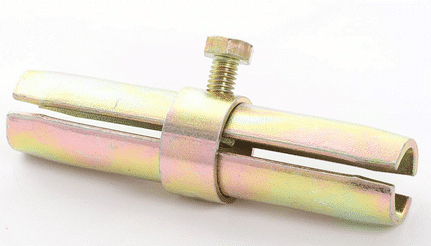
The Joint Pin (also called expandable joint pin, internal scaffold spigot connector, expanding pin, or scaffold joiner) is an internal connector for tubular scaffolding systems. It joins two standard tubes (48.3mm diameter) end-to-end from inside, with a central bolt that expands plates for a secure grip. Designed for non-load-bearing use, it extends upright standards, horizontal ledgers, and handrails without supporting heavy loads. Made from pressed galvanised steel and compliant with EN 74 B and BS1139 Part 2 Section 2 standards, it is durable, corrosion-resistant, and easy to install.
Key Features & Benefits
- Internal expandable design — Sits inside 48.3mm tubes for a clean, streamlined connection that avoids extra bulk on the outside.
- Tubular shape with extended body — Delivers enhanced resistance to bending forces compared to shorter options.
- Simple installation — Just insert into the tube ends and tighten the bolt; the internal plates will grip securely as they expand.
- Pressed galvanised steel construction — Ensures long-lasting strength and reliable weather protection.
- Lightweight and cost-effective — At roughly 0.80kg, it’s easy to manage and more economical than load-bearing fittings.
- Sustainably sourced materials — Promotes environmentally responsible manufacturing practices.
- BS 2482:2009 compliant — Fully meets strict UK scaffolding standards for safety and quality.
This fitting is ideal for light-duty extensions; use external sleeve couplers for heavy loads or essential structural joints.
Specifications Overview
| Specification | Detail |
|---|---|
| To Fit Tube Size | 48.3mm diameter |
| Tube Wall Thickness | 4mm or 3.2mm |
| Material | Pressed Galvanised Steel |
| Type | Drop Forged / Expandable |
| Length | Approximately 250mm |
| Diameter | Approximately 38mm |
| Weight | 0.80kg (approx.) |
| Standard | EN 74 B & BS1139.2.2 – Non Load Bearing |
| Condition | New |
Frequently Asked Questions (FAQs)
What are the recommended usage guidelines?
See the table below for recommended usage guidelines.
Application | Recommended? | Important Notes |
Extending upright standards (vertical) | Yes (non-load-bearing) | Stagger joints and limit to max 10% of total joints in the structure. |
Extending horizontal ledgers | Limited | Use only if the joint is no more than 300mm from a standard tube; otherwise, prefer external sleeves. |
Handrails or guardrails | Yes | Ideal for lighter extensions with minimal load. |
Load-bearing connections | No | Not suitable – use sleeve couplers for heavy loads. |
Alloy scaffolding poles (48.3mm) | No | Use metal sleeves instead. |
Joints in the same bay without reinforcement | No | Strengthen with short tube and swivel couplers (splicing) if required. |
What is the main difference between a joint pin and a sleeve coupler?
A joint pin is an internal connector inserted inside the tubes, making it lighter and more discreet but non-load-bearing. A sleeve coupler fits externally around the tubes and can handle heavier loads.
Can I use this fitting for load-bearing parts of the scaffold?
No. Joint pins are strictly non-load-bearing. For connections under significant weight (e.g., main ledgers or heavily loaded standards), always use load-rated fittings, such as sleeve couplers.
How do I install it?
Insert half of the pin into each tube end, align the tubes, and tighten the central bolt. This expands the internal plates, securely gripping the tube walls.
Are they suitable for alloy tubes?
No, they are designed for standard steel tubes (48.3mm with 4mm or 3.2mm wall thickness). Use appropriate metal sleeves for alloy poles.
How many can I use in one scaffold structure?
As a best practice, joint pins should never exceed 10% of the total joints to maintain overall structural integrity.
Why choose this over other connectors?
It provides a clean, internal connection with good bending resistance, making it perfect for lighter extensions without the added weight or visibility of external fittings.
How do I know if the joint is secure after installation?
After tightening with a 7/16″ scaffolding spanner, give the connection a firm tug or twist by hand; there should be no noticeable play or movement. Visually check that the tubes are correctly aligned and butted together. In practice, a competent scaffolder will also conduct inspections during erection and at periodic checks (as required by the Work at Height Regulations 2005).
Can joint pins be used in tension (pulling forces) as well as compression?
Joint pins perform well under compression (e.g., pushing forces, such as stacking standards vertically) and are often capable of taking the full tube capacity in that mode. However, they have limited tension capacity where tension could occur (e.g., certain bracing or uplift), prefer sleeve couplers, or consult a scaffold designer. Always follow the non-load-bearing classification for critical structural use.
Do I need to stagger joints when using multiple joint pins on a tall scaffold?
Yes, always stagger joints across adjacent standards (never align them at the same level in neighbouring uprights). This prevents weak planes in the structure. Best practice limits joint pins to no more than 10% of the total joints.
What happens if I use a joint pin in the same bay/level without staggering?
If joints occur in the same bay, reinforce immediately with a short tube splice secured by swivel couplers on either side. This creates a stronger “spliced” connection. Failing to reinforce can compromise stability; always follow TG20:21 or your scaffold design.
How does this compare to other internal connectors like spigots in system scaffolding (e.g., cuplock or ringlock)?
This is a tubular/expandable joint pin for independent tube-and-fitting scaffolding. System scaffolds (cuplock, ringlock) often use fixed welded spigots or gravity pins; they’re not interchangeable. This fitting is specifically for 48.3mm tube & coupler setups.
What if the tubes I’m joining have slightly different wall thicknesses (e.g., one 3.2mm and one 4mm)?
It’s best to use tubes of the same wall thickness for optimal grip. Minor variations may still work if appropriately tightened, but for critical applications, match them to ensure even expansion and security.
We sell a complete range of scaffold fittings.
For all your scaffolding needs, explore our range of related scaffold connectors, including double couplers that create strong 90° right-angle joints, swivel clamps for flexible diagonal bracing, and steel scaffolding poles that form the main framework of your scaffold, with fast UK delivery available.
Q & A



Reviews
There are no reviews yet