


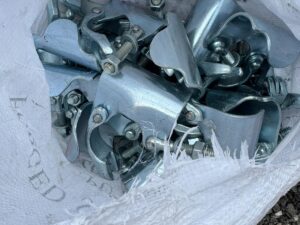
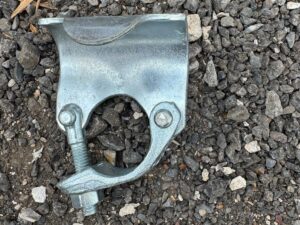
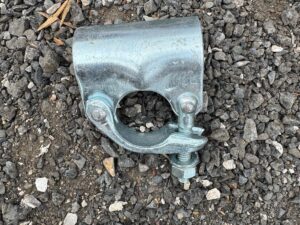


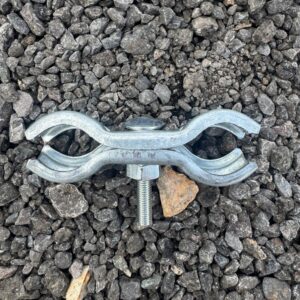
The single coupler is a non-load-bearing, drop-forged scaffolding fitting that securely connects two 48.3 mm scaffold tubes at a fixed 90-degree angle.
Used to attach transom tubes to horizontal ledgers, it helps form stable bases for scaffolding planks and working platforms. It is also commonly used to fix toe boards and guardrails to standards, improving safety on elevated structures. Beyond scaffolding, it’s well-suited to DIY projects such as racking, furniture, signage, stages, and lighting rigs.
Manufactured from galvanised steel with a zinc coating, the single coupler offers excellent corrosion resistance, durability, and reusability. It complies with BS1139-2.2 standards, ensuring reliability for UK construction applications.
Key Features & Benefits
Drop-forged for superior strength and durability over pressed couplers.
Galvanised zinc finish resists rust and weather for long service life.
Fixed 90° connection ensures stable, non-swivel right-angle joints.
Slip resistance rated to 0.63 kN when correctly tightened.
Lightweight (approx. 0.64 kg) for easy handling and fast installation
Simple fit-and-tighten installation using standard scaffold tools.
Cost-effective, versatile solution for professional scaffolding and DIY projects.
Non-load-bearing, ideal for transoms, toe boards, and guardrails.
Specifications Table
| Specification | Details |
|---|---|
| Condition | New |
| To Fit Tube Size | 48.3mm |
| Material | Galvanised Steel |
| Type | Drop Forged |
| Weight | 0.64kg (approx) |
| Standard Compliance | BS1139-2.2 |
| Slip Resistance | 0.63kN (when tightened) |
| Primary Function | Fixed 90° non-load-bearing connection |
| Finish | Zinc-coated for corrosion resistance |
Frequently Asked Questions
What are the typical applications of a single coupler?
Application Type | Primary Use Case | Why Single Coupler? |
Professional Scaffolding | Connecting transoms to ledgers for platforms | Provides stable, right-angle support for planks |
Safety Features | Securing toe boards and guardrails | Ensures edge protection and compliance |
DIY / Non-Scaffolding | Racking, furniture, signage stands, and stages | Versatile, reusable, and easy to install |
Comparison to Swivel Coupler | Fixed 90° vs adjustable angles | Choose single for rigid, cost-effective needs |
Single coupler vs double coupler: Which scaffold fitting fits your build?
In UK tube-and-fitting scaffold systems, selecting the correct coupler ensures structural integrity, HSE compliance, and efficient assembly. The two most common right-angle fittings: single couplers (putlog type) and double couplers (right-angle connectors), look similar but serve distinct roles based on load demands and connection type.
Feature | Single Coupler (Putlog Coupler) | Double Coupler (Right-Angle Coupler) |
Design | Single clamp body gripping one tube onto another at a fixed 90° angle | Two independent clamp bodies for a firmer tube-to-tube grip at a fixed 90° |
Load Capacity | Designed for lighter, secondary connections (non-primary load paths) | Built for higher loads in the main framework (primary structural joints) |
Typical Slip Resistance | Around 0.6–0.7 kN when torqued correctly | Significantly higher (often 1.0+ kN or more per standards) |
Primary Applications | – Fixing transoms/putlogs to ledgers for board support – Securing toe boards to prevent falls – Attaching guardrails or handrails to standards – Edge protection setups | – Joining standards to ledgers (vertical-to-horizontal main frame) – Ledger-to-ledger or standard-to-standard bracing where complete rigidity is needed – Base ties, facade bracing, or heavy platform supports |
Weight (approx.) | ~0.6–0.7 kg – easier for rapid handling on site | ~1.0–1.2 kg – more robust build |
Best For | Platform creation, safety edging, lighter DIY frames (racking, staging) | Core scaffold skeleton, high-load commercial/industrial builds |
Substitution Risk | Not suitable as a replacement in load-bearing positions – can lead to slippage or instability under weight. | Overkill (and heavier/costlier) for simple transom fixing, but safe if used. |
Cost Efficiency | Lower unit price – ideal for high-volume secondary fittings | Higher price justified by strength in critical areas |
Standards Fit | BS1139-2.2 compliant for intended lighter use | BS1139-2.1/EN74 Class B for demanding structural roles |
Expert guidance for UK projects
For years, we have been supplying trades across construction sites. The key rule is: Use double couplers wherever the joint forms part of the main load-bearing frame (e.g., where vertical standards transfer weight through horizontal ledgers). Use single couplers for supporting elements, such as transoms that support scaffold boards, or for adding safety features. Misusing a single coupler in a double’s role risks failing slip tests or compromising platform stability; you should always follow TG20:21 guidance and site-specific designs.
For mixed setups (e.g., independent, tied scaffolds, or system integrations), double couplers provide a margin of safety against uncertain loads. If your project involves heavy materials, frequent access, or heights over 2 lifts, prioritise double couplers at junctions.
This distinction helps avoid common errors, reduces material waste, and supports safer, faster erection.
What is the difference between a single coupler and a swivel coupler?
A single coupler (putlog coupler) creates a fixed 90-degree connection and is non-load-bearing, making it perfect for transoms, toe boards, and guardrails. A swivel coupler allows adjustable angles (up to 360 degrees) for diagonal bracing or irregular structures. Use the single coupler when a rigid right-angle joint is required.
Is the single coupler load-bearing?
No, it is a non-load-bearing fitting designed for connections like transom-to-ledger or guardrail attachments. For primary load-bearing joints (e.g., standards to ledgers), use double right-angle couplers.
How do I install a single coupler?
Wrap the coupler around the two 48.3mm tubes at the desired 90-degree position, then tighten the bolt and nut firmly using a scaffolding spanner or impact wrench. Always ensure proper torque for the specified slip resistance.
Does this product meet UK safety standards?
Yes, this drop-forged single coupler fully complies with BS1139-2.2, a recognised British standard for scaffolding fittings, ensuring quality, safety, and performance.
Can it be used for DIY projects?
Yes, it’s popular for creating sturdy frames for racking, furniture, signage, stages, and lighting setups due to its durability, reusability, and ease of installation.
What torque should I apply when tightening the single coupler?
The recommended tightening torque for most standard scaffolding couplers (including single/putlog types complying with BS1139-2.2) is typically around 50-54 Nm. This achieves the specified slip resistance of 0.63kN. Use a torque wrench or a standard scaffolding spanner with firm, consistent pressure; avoid over-tightening, as it can damage the bolt or fitting. Constantly re-check and re-tighten after initial loading.
How many single couplers do I need per transom or platform?
Typically, two single couplers are used per transom tube (one at each end where it connects to the ledger). This secures the transom properly for scaffold boards. For toeboards or guardrails, one coupler per connection point is usually sufficient.
Can I use a single coupler instead of a right-angle double coupler?
No, do not substitute. The single coupler is non-load-bearing, has lower slip resistance, and is designed only for lighter connections, such as transom-to-ledger, toeboards, or guardrails. Right-angle/double couplers are required for primary structural joints (e.g., ledger-to-standard) where higher loads and full resistance are needed.
Is the single coupler suitable for aluminium scaffolding tubes?
This drop-forged galvanised version is optimised for standard 48.3mm steel scaffolding tubes. While it may fit aluminium poles of the same diameter, always check compatibility and load ratings, as aluminium systems sometimes use lighter couplers. For mixed or aluminium setups, consult the manufacturer or opt for purpose-designed fittings.
How long does the galvanised coating last, and is it suitable for outdoor use?
The zinc/galvanised finish provides excellent corrosion resistance, making it ideal for outdoor and repeated use in UK weather conditions. With proper storage and care, it can last many years and multiple projects. Avoid prolonged exposure to harsh chemicals or standing water to maximise lifespan.
Can single couplers be used on curved or irregular structures?
No, they create only a fixed 90-degree connection. For adjustable angles or diagonal bracing, use a swivel coupler instead. Single couplers excel in straight, right-angle applications.
Helpful videos
Q & A



Reviews
There are no reviews yet